

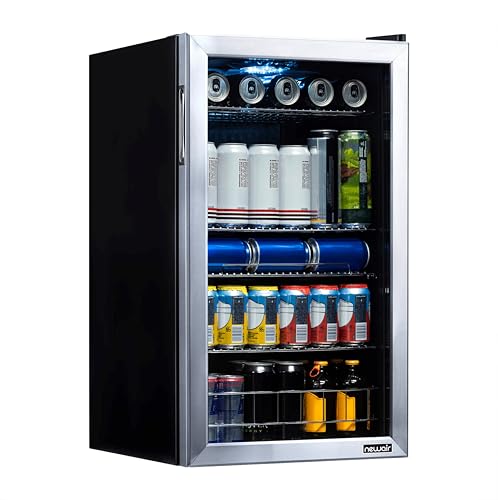
A Newair 60 or 90 can freestanding cooler suits a small apartment or office, the 126 can AB-1200 or 160 can model suits a family that stocks drinks in bulk, the 96 can built-in suits a bar or kitchen cabinet run, and the 24 inch dual-zone unit suits people who want wine and cans in one cabinet at different temperatures. These are the compressor-based models Newair lists on its own site, and the choice among them comes down to capacity, footprint, built-in versus freestanding, and how much noise and temperature consistency you can accept. This guide compares them using the maker’s specifications and attributed buyer feedback.
Our top picks


As an Amazon Associate we earn from qualifying purchases at no extra cost to you.
What a beverage cooler is, and what it is not
A beverage cooler is a compact refrigerator designed for cans and bottles, usually with a glass door, adjustable shelves and a temperature range around that of a standard fridge. Newair’s listings for these models show thermostat ranges starting at 37 degrees Fahrenheit, which is a normal refrigerator temperature. They are not freezers and do not make ice. They are also not the same thing as a wine fridge: wine coolers are designed to hold higher temperatures, although dual-zone models such as Newair’s 24 inch unit combine both.
Specs that matter when choosing
- Capacity in cans. Makers quote a can count based on a specific stacking layout. A full cabinet of mixed bottles and cartons holds fewer. One online commenter said the 126 can figure for the AB-1200 is misleading and that the unit struggles to cool when packed, so leave some breathing room.
- Built-in versus freestanding. A built-in model vents from the front, so it can sit in a cabinet run. A freestanding model usually vents from the back or sides and needs clearance. Putting a freestanding unit in a tight cabinet can cause overheating and shorten its life, so follow the manual.
- Temperature range and zones. Single-zone models list roughly 37 to 65 or 66 degrees Fahrenheit. The 24 inch dual-zone lists a 40 to 66 degree wine zone and a 37 to 66 degree beverage zone.
- Door and shelves. Double-pane glass offers UV protection and insulation. Split or sliding shelves let you store different bottle sizes.
- Noise. Compressor models make a low hum and click. Buyer reviews describe many units as quiet, with a few complaints.
At a glance: Newair models
| Model | Best for | Key stated specs | Limits |
|---|---|---|---|
| 60 can freestanding (black) | Dorm, office, small apartment | About 16.9 inches wide and 20.3 inches tall, 5 thermostat settings, cools to as low as 37 degrees Fahrenheit | Small capacity |
| 90 can freestanding | Small game room or bedroom | About 17 inches wide and 24.4 inches tall, 7 thermostat settings | Still modest; check clearance |
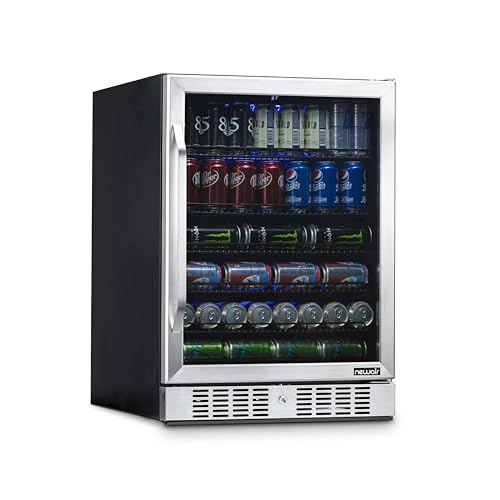
| 96 can built-in ABR-960 | Bar or cabinet run | 14.8 by 33.75 by 22.6 inches, 3.2 cubic feet, 76 pounds, 90 watts, 37 to 66 degrees Fahrenheit | Fixed install, heavy |
| 100 can freestanding | Tight floor space | Under 2 square feet of floor space, double-pane glass door for UV protection and insulation | Mid capacity |
| 126 can AB-1200 | Family or garage drinks stash | 3.6 cubic feet, cools to 37 degrees Fahrenheit, listed as quiet compressor, Newair calls it a best seller | Some buyers report uneven temperatures when full |
| 160 can NBC160SS00 | Large households and parties | Split shelf, digital thermostat, 37 to 65 degrees Fahrenheit, 21 inch wide | Mixed feedback on shelves and noise |
| 24 inch dual zone AWB-365DB | Wine and cans in one cabinet | 23 by 22.4 by 33 inches, 20 bottles and 78 cans, wine zone 40 to 66, beverage zone 37 to 66, R-600A refrigerant | Earlier related model drew reliability complaints |
Small freestanding units: 60, 90 and 100 can
The 60 can model is about 17 inches wide and 20 inches tall, so it fits on a counter or under a desk. Newair lists five thermostat settings and a low of 37 degrees Fahrenheit. The 90 can model keeps the same 17 inch width but stands about 24.4 inches tall with seven settings, which adds a few shelves of space without growing the footprint. The 100 can model is described as taking less than two square feet of floor and uses a double-paned glass door for UV protection and extra insulation. These are good fits for people who want cold cans without buying a full-size fridge. The trade-off is limited capacity: stocking bottles and larger cartons can eat up space quickly.
Large freestanding units: 126 and 160 can
The 126 can AB-1200 is rated at 3.6 cubic feet with a quiet compressor and a low of 37 degrees Fahrenheit. Buyer reviews describe it as keeping drinks cold and running quietly, while some buyers report inconsistent temperatures. An online commenter warned that the capacity number is aspirational and that it works harder when full. The 160 can model has a split shelf configuration and a digital thermostat from 37 to 65 degrees Fahrenheit. One buyer reviewer praised the sliding shelves, quiet operation and one-touch light, while another called the shelves weak and the unit noisy. In short, the two big models can suit heavy drinkers of cans, but opinions on build quality are mixed, so look at the warranty terms.
Built-in 96 can: ABR-960
This is the model for a bar cabinet or outdoor-style kitchen run where a front-venting unit slides under a counter. Newair lists dimensions of 14.8 inches wide, 33.75 inches tall and 22.6 inches deep, a capacity of 3.2 cubic feet, a weight of 76 pounds, a 90 watt draw and a 37 to 66 degree Fahrenheit range. Measure the cabinet opening and the doorway you need to carry it through. If it is going outdoors, only use a model that the maker rates for outdoor use, since indoor units are not designed to handle weather.
Dual zone: 24 inch wine and beverage
The AWB-365DB, a newer variant of the earlier AWB-360DB, has French doors and two zones: a wine zone at 40 to 66 degrees and a beverage zone at 37 to 66. Newair lists 20 bottles and 78 cans, with R-600A refrigerant. Owner reviews of the related AWB-360DB include reports of the unit stopping cooling after under three years and resetting to a high temperature after a power outage. That is anecdotal and relates to the earlier version, but it is worth considering when you look at warranty length.
Choosing capacity honestly
Can counts are best read as an upper bound. A cabinet that holds 126 slim cans in an ideal layout holds far fewer mixed bottles, cartons and tall bottles. If you drink mostly cans, buy the count you need. If you keep bottles of sparkling water, mixers and wine, step up one size or choose the dual-zone cabinet. Also leave a little free space in the cabinet so cold air circulates, since several buyer comments tie uneven temperatures to overfilling.
Budget tiers
- Budget. The 60 and 90 can freestanding models, which are the cheapest way into Newair.
- Mid-range. The 100, 126 and 160 can freestanding units.
- Premium. The 96 can built-in and the 24 inch dual-zone wine and beverage cooler, where the cost reflects the cabinet-grade finish and zones.
Fit, ventilation and care
- Clearance. Leave the gap the manual specifies behind and beside a freestanding unit. A cramped spot raises compressor temperature.
- Level floor. Use the adjustable feet so the door closes and the compressor sits level.
- Settling time. After transport, let the unit stand upright for the period in the manual before plugging in.
- Cleaning. Unplug before cleaning, wipe with mild soap, and keep the door gasket clean so it seals.
- Power outages. Some owners report that settings revert after an outage. Check the temperature after power returns.
- Do not store medicine or breast milk in a beverage cooler unless the maker rates it for that. Its temperature stability is not designed for such storage.
Pick X if you
| If you | Pick |
|---|---|
| Want the smallest floor footprint | Newair 60 or 100 can freestanding |
| Need a cabinet-run install | Newair 96 can built-in ABR-960 |
| Stock cans in bulk | Newair 126 can AB-1200 or 160 can NBC160SS00 |
| Keep wine and cans together | Newair 24 inch dual zone |
| Want a lower temperature than 37 degrees | A different appliance, since these models start at 37 |
| Need outdoor use | A model that the maker explicitly rates for outdoors |
Alternatives
Other brands of beverage fridge. Edgestar, Kalamera, Antarctic Star and Whynter all sell similar cabinets.
A mini fridge. If you also need to store food, a compact fridge offers more flexible shelves.
A thermoelectric mini cooler. Cheaper and quieter, but it only cools a small amount below room temperature.
Frequently Asked Questions
How cold does a Newair beverage cooler get?
Newair’s listings show a low of 37 degrees Fahrenheit, with upper ranges around 65 or 66 degrees depending on the model.
Can I build it into a cabinet?
Only models designed for it. The 96 can ABR-960 is described as built-in. Freestanding models need ventilation space, so follow the manual.
Are the large models noisy?
Opinions differ. Some buyers call the 126 and 160 can units quiet, while others report noise, so consider placing them away from bedrooms.
Does a full cooler stay cold?
A heavily packed cooler with no airflow can struggle. One commenter reported that the 126 can unit has trouble when packed, so keep gaps between items.
Is the dual-zone good for wine?
The wine zone ranges from 40 to 66 degrees Fahrenheit. That suits many everyday bottles, but serious collectors may want a dedicated wine cellar unit.
What about reliability?
Buyer reports vary. Some owners of an earlier dual-zone model reported cooling failures after under three years. Check warranty length and keep proof of purchase.








Write Your Review
No reviews yet. Be the first to share your experience!