

Key takeaways
- Keep food cold: Food safety guidance generally calls for perishable food to stay at 40 F or below. A thermometer in the cooler is a simple check.
- Separate raw meat: Keep raw meat in sealed containers on the bottom, away from ready-to-eat food.
- Drain and dry: Wash with mild soap, rinse, and leave the lid open to dry so odors do not build up.
- Check the drain plug: Close it before packing, and follow the maker’s manual for gasket care.
- Weight limits: Some coolers are rated as seats, and others are not. Follow the maker’s instructions before sitting on one.
The best wheeled cooler for most buyers is the YETI Roadie 48 Wheeled or the YETI Tundra Haul if you want a premium rotomolded roller, the RTIC 45 or Magellan Outdoors Pro Explore 45 if you want similar hauling with a lower budget, and the Coleman 50-Quart Xtreme or Coleman Classic 65 Wheeled if you mostly want a light cooler for day trips. Choose by how long you need ice to last, how rough the ground is, and how much you want to carry when it is loaded.
Our top picks


As an Amazon Associate we earn from qualifying purchases at no extra cost to you.
Wheeled Coolers at a Glance
The figures come from Outdoor Life’s wheeled cooler test, OutdoorGearLab, America’s Test Kitchen and Treeline Review, which report their own measurements and the makers’ stated sizes. Ice retention times depend on the test conditions, so use them to compare coolers rather than as promises.
| Model | Reported capacity | Reported weight (empty) | Reported ice retention | Best for | Limit |
|---|---|---|---|---|---|
| YETI Roadie 48 Wheeled | 48 qt | 28 lb | 62 hours in Outdoor Life’s test | Easy maneuvering, strong warranty | Premium tier; not the top insulation performer |
| YETI Tundra Haul | Large hard cooler | Heavy; about 105 lb loaded with cans per OutdoorGearLab | 5.4 days to reach 40 F in OutdoorGearLab’s test | Durable big-trip cooler | Premium tier and heavy |
| RTIC 45 Ultra-Tough Wheeled | 45 qt | 33 lb | 55 hours | Lower-cost rotomolded | Uncomfortable haul handles per Outdoor Life |
| RTIC 52 Ultra-Light | 52 qt | 21 lb | 55 hours in Outdoor Life; OutdoorGearLab reports 5.8 days to 40 F | Lighter, value | Insulation described as poor by Outdoor Life |
| RovR RollR 45 | 45 qt | 37 lb | 69 hours | Rough terrain, big puncture-resistant tires | Latches take force |
| Magellan Outdoors Pro Explore 45 | 45 qt | 30 lb | 73 hours | Value, comfortable handles | Short handle, struggles on rough ground |
| Pelican 45QW Elite | 45 qt | 39 lb | 50 hours | Lifetime warranty | Costly; moderate ice retention |
| Igloo Trailmate Journey 70 | 70 qt | 35 lb | 44 hours | Big family trips | Mediocre insulation; large |
| Brumate Brutank 35 | 35 qt | 31 lb | 77 hours (longest) | Longest ice life | Smaller interior, sticky handle |
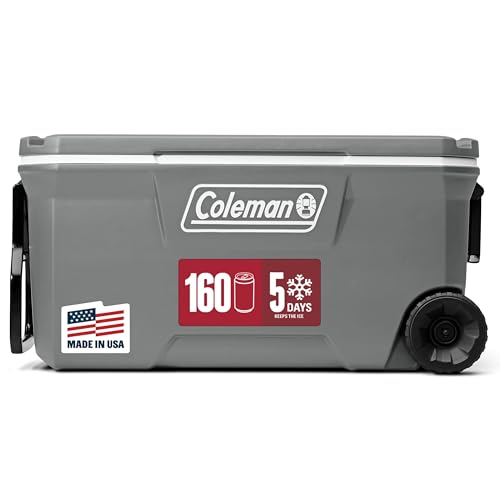
| Coleman 50-Quart Xtreme | 50 qt | 13 lb | 40 hours | Budget, light | Shortest ice life; half wheels only |
| Coleman Classic 65 Wheeled | 65 qt | Lighter than rotomolded | 4.7 days to 40 F in OutdoorGearLab | Overall value per OutdoorGearLab | Less durable |
Rotomolded, Hard-Sided or Soft?
Rotomolded coolers, like YETI, RTIC, RovR and Pelican, have thick, seamless shells with thick insulation. They hold ice longest, take abuse and weigh the most. Injection-molded hard coolers such as the Coleman Xtreme and Classic are lighter and cheaper, hold ice for a shorter time, and tend to be less durable, as America’s Test Kitchen noted of the Coleman, which it named its Best Buy. Soft-sided rolling coolers, such as the Titan 60-can model in Outdoor Life’s test at about 7 lb, are very light and convenient for picnics but gave only about 38 hours of ice retention.
The heavier a cooler is empty, the more important wheels become, because a full rotomolded cooler can weigh over 100 lb. OutdoorGearLab put a loaded YETI Tundra Haul at roughly 105 lb with cans, against about 92 lb for the Coleman wheeled 65.
Wheels and Handles Matter More Than You Think
Treeline Review made the YETI Haul its leading contender but preferred the RovR RollR on rocks and uneven ground because of its puncture-resistant tires. Outdoor Life calls the RovR wheels capable of “any and all terrain” and singles out the Magellan for struggling on rough terrain. That is the clearest dividing line among wheeled coolers: if you stick to pavement, boardwalks and campground paths, small wheels are fine; for sand, gravel or trails, choose large, wide tires.
Handles come in two kinds. A telescoping pull handle like the Roadie’s is comfortable for tall users, whereas short handles on the Magellan and Pelican force you to bend. Side grab handles need to be comfortable when two people lift the cooler into a truck, and Outdoor Life criticizes the RTIC 45’s haul handles for being uncomfortable. If you will lift your cooler into the back of a car often, weigh the empty weight carefully.
Capacity: How Big Is Big Enough?
Cooler capacity is usually given in quarts. A 45 to 50 quart cooler holds enough for a weekend for two people or a day trip for a family. A 65 to 70 quart model suits groups. A general guideline from many makers is that about two thirds of the space should be ice, so the usable food capacity is much smaller than the label suggests. The Brumate Brutank 35 gives the longest ice life in Outdoor Life’s test, but reviewers note its smaller interior.
When you buy bigger, you also buy weight. An Igloo Trailmate Journey 70 is reported at 35 lb empty. Add ice and drinks and the weight jumps fast, so the wheel quality matters even more.
Ice Retention in Real Use
The numbers in reviews come from controlled tests, usually with a set ratio of ice to air and a cooler kept in the shade. In real use, ice lasts less long when the lid is opened often, when the cooler sits in direct sun, or when warm drinks are put in. Pre-chilling the cooler with sacrificial ice, using block ice, and filling empty space reduce melt. These are broadly accepted tips from cooler makers and reviewers, but results differ with the weather.
Outdoor Life lists ice melt times from 38 hours for the soft cooler to 77 hours for the Brumate. OutdoorGearLab reports the Haul took 5.4 days to reach 40 F, the RTIC 52 Ultra-Light 5.8 days, and the Coleman Classic 65 4.7 days. Different tests measure different things, so look at both ranking and margin: the gap between premium and budget is real but smaller than the gap in pricing.
Food Safety and Care
- Keep food cold: Food safety guidance generally calls for perishable food to stay at 40 F or below. A thermometer in the cooler is a simple check.
- Separate raw meat: Keep raw meat in sealed containers on the bottom, away from ready-to-eat food.
- Drain and dry: Wash with mild soap, rinse, and leave the lid open to dry so odors do not build up.
- Check the drain plug: Close it before packing, and follow the maker’s manual for gasket care.
- Weight limits: Some coolers are rated as seats, and others are not. Follow the maker’s instructions before sitting on one.
Loading, Lifting and Vehicle Fit
Wheels help on the ground but not on stairs or into a trunk. Before buying, measure the cargo area and the lift height of your vehicle. Compare the empty weights above: a Coleman Xtreme at about 13 lb is simple to hoist, while a Pelican at about 39 lb or a RovR at about 37 lb is already a two-hand job before any ice goes in. If you are traveling alone, pack the cooler in stages, with drinks and food added after it is in place.
Wheeled coolers also need to be stable when parked. A cooler that tips when you let go of the handle is a nuisance on a slope, so look at whether the model stands on its own base and how its wheels sit. Some owners add a cargo strap to keep the lid closed while rolling over curbs, which prevents ice water from sloshing through any gap.
For camping, think about bears and wildlife rules at your destination. Some parks require certified bear-resistant containers, and a standard wheeled cooler may not meet them, so check the rules for your area with park staff. For boating and fishing, a cooler that drains cleanly and resists saltwater corrosion matters, and stainless steel hardware is a plus.
Finally, consider how often you will actually use the wheels. If your trips are mostly to a tailgate or a beach where the car parks close, a lighter non-wheeled cooler with a separate cart can serve better, as the heavy wheel assembly adds weight you will carry on every trip.
Budget Tiers
Budget: Coleman wheeled models and soft rolling coolers. Light and easy to move, with shorter ice life, and less durable.
Mid-range: RTIC, Magellan and some Igloo models. These give rotomolded-style insulation and wheels for less than the top brands, with trade-offs in handles and rough-ground ability.
Premium: YETI, RovR, Pelican and Brumate. You pay for ice retention, build quality, warranty and, in the RovR’s case, tires made for rough ground.
Pick X If You Want Y
| Pick this | If you want |
|---|---|
| YETI Roadie 48 Wheeled | A premium, easy-to-maneuver cooler with a strong warranty |
| YETI Tundra Haul | The most durable big roller |
| RovR RollR 45 | Rough-terrain wheels |
| Magellan Pro Explore 45 or RTIC 45 | A budget-friendlier rotomolded cooler |
| Brumate Brutank 35 | The longest ice retention in a smaller size |
| Coleman Classic 65 or Xtreme 50 | A light, low-cost cooler for short trips |
| Igloo Trailmate Journey 70 | Maximum space for groups |
| Pelican 45QW Elite | A lifetime warranty |
Alternatives Worth Considering
- Cooler with a separate cart: A standard hard cooler plus a folding wagon or dolly carries the same load and lets you change the cooler later.
- Soft rolling cooler: Very light for picnics and short trips, though ice life is shorter.
- Powered cooler: A 12-volt cooler or fridge keeps food cold without ice for road trips, but needs a power source.
Frequently Asked Questions
Are wheeled coolers worth it?
If you carry a full cooler any distance, wheels save your back. They add weight and cost, so a standard cooler is fine if you load it next to your vehicle.
Which wheeled cooler keeps ice longest?
In Outdoor Life’s test, the Brumate Brutank 35 held ice longest at 77 hours, followed by the Magellan at 73 and the RovR at 69. Other outlets rank products differently depending on their test.
Do wheels work on sand?
Small hard wheels sink in sand. Large, wide tires such as the RovR’s handle soft ground better, according to reviewers. For a beach trip, consider a dedicated beach cart.
How much cooler do I need?
A 45 to 50 quart cooler covers a weekend for two. Larger groups benefit from 65 quarts and up. Remember that ice takes up much of the space.
Can I sit on my cooler?
Only if the maker states it is designed for it. Wheeled designs may have a different lid construction. Read the manual.
How do I clean and store it?
Wash with mild soap and warm water, rinse, and dry with the lid open. Store with the drain open and the lid ajar, away from direct sun.









Write Your Review
No reviews yet. Be the first to share your experience!