

Key takeaways
- Compare the best tds meters for brewing water, RO checks and hydroponics, with each maker's printed range, resolution, accuracy and calibration details.
As an Amazon Associate we earn from qualifying purchases.
Brewers build water on purpose: a reverse-osmosis membrane strips the minerals out, then salts go back in measured amounts for the style in the fermenter. A handheld TDS meter is the quick check that ties that work together. It tells you whether the membrane is still rejecting, what the tap water started at, and how strong a hydroponic nutrient mix is before it reaches the reservoir.
One point needs stating plainly before any pick: a TDS reading is an estimate. The meter measures electrical conductivity and multiplies it by a conversion factor to display parts per million, so the number depends on which factor the maker chose. It is not a safety test, and it cannot detect contaminants that do not conduct. Every figure below is the figure the maker prints for that exact model, attributed to the maker.
Disclosure: this page contains affiliate links, and the site may earn a commission on qualifying purchases at no added cost to you.
Quick Answer
For most brewers, the HM Digital TDS-3 is the default check: a single-purpose pen with a printed plus or minus 2 percent readout accuracy and a case. Step up to the HM Digital COM-100 for true EC readings in a waterproof body, the Bluelab pen for switchable TDS scales, the Vivosun pen for a low-cost TDS, EC and temperature readout, and the TDS-EZ for the simplest budget check.
HM Digital TDS-3 Handheld TDS Meter

The TDS-3 is the pen filter companies bundle and brewers keep in a drawer, and its listing prints the figures plainly: a range of 0 to 9,990 ppm, 1 ppm resolution, and plus or minus 2 percent readout accuracy. It reads TDS only, with a built-in thermometer driving automatic temperature compensation, a hold function that freezes the reading, and an auto-off after ten minutes. HM Digital factory-calibrates each unit; if it ever needs recalibrating, the maker directs you to a small screwdriver adjustment against a 342 ppm NaCl calibration solution. A vinyl carrying case with a belt clip is included, per the listing.
Specs
- Measurement range: 0 to 9,990 ppm
- Resolution: 1 ppm (10 ppm above 999 ppm, per HM Digital)
- Accuracy: plus or minus 2 percent readout accuracy (as printed in this model’s listing)
- Automatic temperature compensation: yes, with built-in thermometer
- Calibration: factory calibrated; recalibration by screwdriver adjustment against 342 ppm NaCl solution, per HM Digital
- Calibration solution included: not stated
- Battery: 2 LR44 cells (included, per the listing)
- Extras: hold function, auto-off, carrying case included
See the HM Digital TDS-3 on Amazon
HM Digital COM-100 Waterproof EC/TDS/Temp Meter
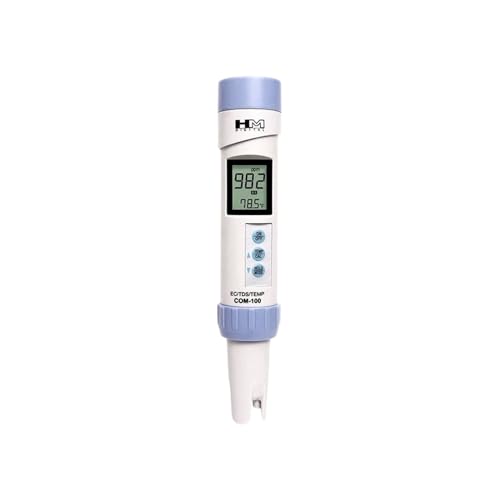
The COM-100 is HM Digital’s professional-series combo meter, and it is the pick here for anyone who wants conductivity itself rather than only the converted number. HM Digital prints an EC range of 0 to 9,990 microsiemens and a TDS range of 0 to 8,560 ppm on the 0.7 conversion scale (0 to 5,000 ppm on the 0.5 scale), with plus or minus 2 percent accuracy. Three conversion curves are selectable (KCl, 442 and NaCl), which matters because a ppm figure only means something alongside the scale that produced it. The housing is rated IP67 waterproof and floats, the sensor (model SP-C1) is replaceable, and calibration is digital push-button at any point in the range.
Specs
- EC range: 0 to 9,990 microsiemens; 0 to 9.99 millisiemens
- TDS range: 0 to 8,560 ppm (0.7 scale); 0 to 5,000 ppm (0.5 scale)
- Accuracy: plus or minus 2 percent (as printed by HM Digital for this model)
- Automatic temperature compensation: yes
- Calibration: digital push-button, any point in range; factory calibrated with 1413 microsiemens solution
- Conversion scales: KCl, 442 and NaCl, selectable
- Sensor replaceable: yes, SP-C1
- Waterproof rating: IP67 (per HM Digital); floats
- Battery: not stated
See the HM Digital COM-100 on Amazon
HM Digital TDS-EZ Water Quality TDS Tester

The TDS-EZ is the stripped-down member of the same family: one button, one number. Its listing prints a range of 0 to 9,990 ppm, 1 ppm resolution, and plus or minus 3 percent readout accuracy, a looser printed tolerance than the TDS-3 carries. There is no EC mode and no temperature readout, which is the honest trade for the lowest cost in this list. It has a hold function and an auto-off feature, and HM Digital rates battery life at approximately 1,000 hours. It arrives factory calibrated, and recalibration, when needed, is done with a mini screwdriver against a known solution, per the maker.
Specs
- Measurement range: 0 to 9,990 ppm
- Resolution: 1 ppm (10 ppm above 999 ppm, per HM Digital)
- Accuracy: plus or minus 3 percent readout accuracy (as printed in this model’s listing)
- Automatic temperature compensation: yes (per HM Digital)
- Calibration: factory calibrated; recalibration by mini screwdriver adjustment, per HM Digital
- Calibration solution included: not stated
- Battery: approximately 1,000 hours of life (per the listing)
- Extras: hold function, auto-off
See the HM Digital TDS-EZ on Amazon
Vivosun TDS Tester 3-in-1 TDS, EC and Temperature Meter (Blue)

The blue Vivosun pen (model 305132-PEN) is the low-cost way to get three readings from one dip: TDS, EC and temperature. Vivosun prints a TDS range of 0 to 9,990 ppm and an EC range of 0 to 9,990 microsiemens per centimetre for this pen, with accuracy of plus or minus 2 percent and a temperature range of 0.1 to 80.0 degrees Celsius. It has automatic temperature compensation and a hold function. Vivosun notes that this meter cannot test seawater, consistent with a range that tops out below seawater strength. As with the Vivosun pH pen in our pH meters guide, treat the printed figures as the maker’s own numbers for an entry-level pen and check it against a known solution before trusting it on brew day.
Specs
- TDS range: 0 to 9,990 ppm
- EC range: 0 to 9,990 microsiemens per centimetre
- Accuracy: plus or minus 2 percent (as printed by Vivosun for this model)
- Temperature range: 0.1 to 80.0 degrees Celsius
- Automatic temperature compensation: yes
- Calibration: not stated
- Battery: not stated
- Extras: hold function; Vivosun states the meter cannot test seawater
See the Vivosun TDS Tester on Amazon
Bluelab Conductivity Pen (PENCON)

The Bluelab pen is the hydroponics-first pick, built around switchable scales. Bluelab’s datasheet for the PENCON prints conductivity ranges of 0.0 to 10.0 EC and 0 to 100 CF, with TDS readouts of 0 to 5,000 ppm on the 500 scale and 0 to 7,000 ppm on the 700 scale, so a solution can be reported the way a nutrient recipe expects. Resolution is 0.1 EC and 10 ppm, and Bluelab prints accuracy of plus or minus 0.1 EC and plus or minus 50 ppm on the 500 scale, measured at 25 degrees Celsius. The pen is fully waterproof and floats, has a backlit display and a hold function, and runs on a single AAA battery, included. Bluelab describes calibration as optional: the pen is factory calibrated, shows a successful-calibration indicator for 30 days, and can be recalibrated with the maker’s conductivity standard when you choose.
Specs
- Measurement ranges: 0.0 to 10.0 EC; 0 to 100 CF; 0 to 5,000 ppm (500 scale); 0 to 7,000 ppm (700 scale)
- Resolution: 0.1 EC; 1 CF; 10 ppm (as printed in Bluelab’s datasheet)
- Accuracy: plus or minus 0.1 EC; plus or minus 50 ppm (500 scale), at 25 degrees Celsius (as printed in Bluelab’s datasheet)
- Automatic temperature compensation: yes
- Calibration: optional; factory calibrated, recalibratable with the maker’s conductivity standard
- Waterproof: fully waterproof (per Bluelab); floats
- Battery: 1 AAA alkaline cell (included)
- Extras: backlit display, hold function, auto-off, low battery indicator
See the Bluelab Conductivity Pen on Amazon
How to Choose
Start with the scale question, because it decides whether two readings can be compared at all. A TDS number is conductivity multiplied by a conversion factor: roughly 0.5 on the NaCl scale, 0.7 on the 442 scale. The same water can read about 100 ppm on one meter and noticeably higher on another using a different factor, with nothing wrong with either pen. If a nutrient recipe or a water report quotes EC, choose a meter that displays EC directly (the COM-100 or the Bluelab pen) instead of converting.
Next, separate resolution from accuracy the same way you would with a pH pen. Resolution is the step size on the display; accuracy is the tolerance the maker prints for the reading. For membrane checks, what matters is repeatability at low numbers: watching RO output creep from 8 to 15 ppm over a season tells you the membrane is tiring, and any pen here resolves finely enough to show that climb. Then check the calibration story: meters that calibrate against a standard solution can be brought back to a known value, while a pen with no calibration route is a consumable. Finally, match the body to the work: an IP67 waterproof housing earns its keep around reservoirs, sinks and fermenters.
Who Should Skip
Skip a TDS meter entirely if what you actually need is a safety verdict on drinking water. These pens estimate dissolved solids from conductivity; they cannot detect lead, bacteria, PFAS or anything else that does not conduct, and a low reading is not evidence that water is safe. Skip the TDS-only pens if your recipes are written in EC, because converting with the wrong factor quietly corrupts every feeding decision. Skip handheld pens for samples beyond their printed ranges; the Vivosun pen states its seawater limit outright. And skip the cheapest pens if you will never check them against a calibration solution, because an unverified number you trust is worse than no number.
FAQ
What does a TDS meter actually measure?
It measures electrical conductivity, then multiplies the result by a conversion factor the maker chose (commonly about 0.5 or 0.7) to display an estimated dissolved solids figure in parts per million. Two meters using different factors will show different ppm values for the same water, which is why EC readings transfer between setups more reliably.
How do I use one to check a reverse-osmosis membrane?
Read the feed water and the membrane’s output water back to back with the same meter, at similar temperatures. The output should be a small fraction of the feed reading. Track that figure over time: a slow, steady climb is the practical sign that the membrane is losing rejection and approaching replacement.
How often should I calibrate a TDS meter?
Check it against the maker’s calibration solution whenever a reading will drive a decision, such as mixing a nutrient batch to a target or condemning a membrane, and recalibrate if it has drifted. Conductivity probes are hardier than pH electrodes and need no storage solution, but a pen’s printed accuracy only holds while its calibration does.
Can a TDS meter tell me if my water is safe to drink?
No. It estimates dissolved solids that conduct electricity. Many contaminants of concern do not register on a conductivity reading at all, and a low TDS figure says nothing about microbiological or chemical safety. Use a certified laboratory test for safety questions; use a TDS pen for process questions such as filter performance and nutrient strength.
Final Verdict
For a first meter, the HM Digital TDS-3 remains the reference pen: its printed plus or minus 2 percent readout accuracy, hold function and included case make membrane and tap-water checks hard to get wrong. The COM-100 is the upgrade for growers and brewers who think in EC and want a waterproof body with a replaceable sensor. The Bluelab pen suits hydroponic growers whose recipes switch between the 500 and 700 scales. The Vivosun pen covers TDS, EC and temperature for the least outlay, and the TDS-EZ is the single-purpose budget check. Whichever you choose, learn its conversion factor before comparing its numbers to anyone else’s.
Product and ASIN Reference
| Product | ASIN |
|---|---|
| HM Digital TDS-3 Handheld TDS Meter | B000VTQM70 |
| HM Digital COM-100 Waterproof EC/TDS/Temp Meter | B0045LQFTK |
| HM Digital TDS-EZ Water Quality TDS Tester | B002C0A7ZY |
| Vivosun TDS Tester 3-in-1 TDS, EC and Temperature Meter (Blue) | B01N2O1Z5B |
| Bluelab Conductivity Pen (PENCON) | B005IGXOK4 |
More from Amazon
Programs that pair well with the guide above. Offers and eligibility are set by Amazon and may change.
Set up recurring deliveries of everyday items on eligible products. Terms and savings are set by Amazon.
Explore Subscribe & SaveCollect the home and kitchen items you want in one registry that guests can shop from.
Create a wedding registryFree shipping on eligible items, Prime Video and more. Eligible new members can start with a free trial.
Start a Prime free trialAudiobooks and podcasts to listen to on the go. Eligible new members can start with a free trial.
Try Audible freeAs an Amazon Associate we earn from qualifying purchases.


Write Your Review
No reviews yet. Be the first to share your experience!