

Key takeaways
- Compare five coffee grinders for home use, from a 40-setting burr mill to a blade model and a hand grinder, with printed settings and hopper sizes.
As an Amazon Associate we earn from qualifying purchases.
Grinding beans just before brewing is the change most home coffee drinkers notice first, and the grinder you pick decides how much control you get over that grind. These five coffee grinders cover the main designs sold for home kitchens: a straightforward electric burr grinder, an espresso-focused burr grinder with timed dosing, a large-capacity flat burr mill, a blade grinder, and a manual hand grinder.

Each pick below is specced from what its maker prints for the exact model: the burr type, the number of grind settings, the hopper capacity, and the wattage where one applies. Where a maker promises a tastier cup, that wording is the maker’s own claim, attributed as such.
This article contains affiliate links, and if you buy through one of them the site may earn a commission at no extra cost to you.
Quick Answer
For most kitchens, the Baratza Encore is the default pick: 40 grind settings on 40 mm conical burrs and a 300 g hopper. Espresso drinkers should look at the Breville Smart Grinder Pro, with 60 settings and timed dosing. The Cuisinart DBM-8 holds the most grounds, the SHARDOR is the simple blade option, and the JavaPresse is the manual pick.
Baratza Encore Conical Burr Grinder
See the Baratza Encore on Amazon
The Encore is the electric burr grinder Baratza positions as its go-to entry-level home model, and the controls are as simple as this category gets. You twist the bean hopper itself to move through 40 grind settings, then run the machine with the side on/off switch or the front pulse button. The burrs are 40 mm conical steel burrs, which Baratza describes as manufactured in Europe, and Baratza prints a grind speed of 1.3 grams per second at setting 10, rising to 2.2 grams per second at setting 30.
The hopper printed in the listing holds 300 g of beans, and the grounds bin below it is printed at 5 oz, so a household that brews a pot at a time can grind several rounds before emptying. Baratza also makes replacement parts and a repair service a stated part of the offer.
Specs
- Burr type: 40 mm conical steel burrs (M3)
- Grind settings: 40
- Bean hopper capacity: 300 g (10.6 oz) as printed in the listing
- Grounds bin capacity: 5 oz (142 g)
- Wattage: 120 watts
- Controls: on/off switch plus front pulse button; grind adjusted by rotating the hopper
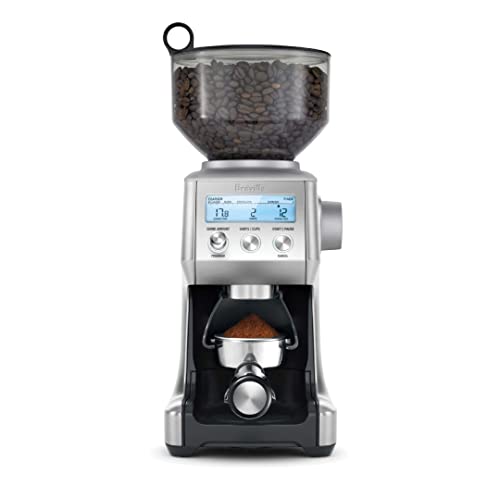
Breville Smart Grinder Pro
See the Breville Smart Grinder Pro on Amazon
The Smart Grinder Pro is the espresso-focused pick. Breville prints 60 grind settings, and its own coffee chart gives the fine half of that range, settings 1 to 30, to espresso, with percolator and drip in the middle bands and French press at 55 to 60. Dosing is by time rather than by a cup dial: the Dosing IQ timer adjusts in 0.2-second increments, and the grinder can dose straight into a portafilter using the included cradles.
The bean hopper is the largest here at 18 oz, and an adjustable upper burr lets you shift the whole 60-step range finer or coarser from its factory setting, which Breville prints as position 6. The trade-off is complexity: an LCD screen, two dials, and a removable burr set are more to learn and clean than the Encore’s twist-and-go layout. For a home espresso setup that also has to cover a weekend French press, Breville’s printed range is the widest here.
Specs
- Burr type: stainless steel conical burrs
- Grind settings: 60 (Breville’s chart assigns settings 1–30 to espresso)
- Bean hopper capacity: 18 oz (510 g)
- Wattage: 165 watts
- Dosing: electronic timer adjustable in 0.2-second increments; grinds into a portafilter
- Extra adjustment: adjustable upper burr with 10 positions, factory set at 6
Cuisinart Supreme Grind Automatic Burr Mill DBM-8

See the Cuisinart DBM-8 on Amazon
The DBM-8 is the large-capacity pick, and the capacity that matters is at the bottom, not the top. Its bean hopper holds 8 oz, a mid-pack figure, but the grind chamber below holds enough ground coffee for up to 32 cups as Cuisinart prints it, the most here. A slide dial doses for 4 to 18 cups and an electric timer shuts the unit off when the cycle ends, so batch grinding is a one-touch job.
The burrs are flat rather than conical, and the grind selector offers 18 positions from ultra-fine to extra-coarse, the joint fewest settings here alongside the JavaPresse. Those steps are wide, which is why this mill suits drip pots and big batches better than fine espresso adjustments. Both the hopper and the grind chamber lift out for emptying and cleaning, and Cuisinart includes a scoop and cleaning brush.
Specs
- Burr type: flat burrs, stainless steel
- Grind settings: 18 positions, ultra-fine to extra-coarse
- Bean hopper capacity: 8 oz
- Grounds chamber capacity: holds grounds for up to 32 cups, as printed
- Dose control: slide dial for 4 to 18 cups with automatic shutoff
- Wattage: 500 watts
SHARDOR Electric Coffee Grinder CG715

See the SHARDOR CG715 on Amazon
This is the blade grinder, labelled plainly: there are no burrs in it. A stainless steel blade spins at the bottom of a removable stainless steel bowl and cuts the beans, and there are no numbered grind settings at all. How fine the result gets is decided by how long you run the motor, and SHARDOR’s own guidance times it in seconds, shorter runs for coarse grounds and longer runs for finer ones.
What the design gives back is simplicity and a second job. The bowl lifts out for filling, pouring, and washing, holds 70 g of beans, which the listing puts at up to 12 cups of coffee, and the same machine is sold for spices and herbs as well as coffee. If you brew with a forgiving method like French press and want the smallest motor-driven grinder style there is, this is that design, with its limits stated up front.
Specs
- Grinding type: blade grinder (stainless steel blade, no burrs)
- Grind settings: none; fineness is controlled by run time
- Bowl capacity: 70 g (2.5 oz), printed as up to 12 cups of coffee
- Wattage: 200 watts
- Bowl: removable stainless steel bowl for filling, pouring, and cleaning
- Also sold for: spices and herbs, per the listing
JavaPresse Manual Coffee Grinder
See the JavaPresse Manual Grinder on Amazon
The JavaPresse removes the motor entirely. It is a stainless steel hand grinder with a ceramic conical burr inside and a detachable hand crank on top, so it needs no cord, no outlet, and no counter space beyond a drawer. JavaPresse prints over 18 adjustable grind settings, set by turning a knob under the burr assembly in clicks; its manual suggests 1 to 3 clicks from finest for espresso and 13 to 18 for French press and cold brew.
The compromises are physical. Every gram is ground by hand, the chamber is small because the whole tool is built to travel, and the listing does not print a bean capacity figure, so treat it as a one-or-two-cup grinder rather than a batch machine. In exchange you get the quietest grinder here and the only one that works in a tent, a cabin, or a kitchen during a power cut.
Specs
- Burr type: ceramic conical burr
- Grind settings: over 18, adjusted in clicks by a knob under the burr
- Power: none; detachable hand crank
- Body: stainless steel
- Bean capacity: not stated in the listing
- Recommended clicks as printed: 1–3 espresso, 7–9 drip and pour over, 13–18 French press and cold brew
How to Choose
Start with the mechanism, because it decides everything else. Burr grinders crush beans between two burr surfaces at a set gap, which is why they can offer numbered settings at all. A blade grinder has no gap and no settings: it chops beans with a spinning blade, rather than grinding them, so particle size depends on run time and is never as even. Choose a blade model only if your brew method is forgiving.
Next, count the settings against your brew methods. Drip and French press drinkers are well served by 18 wide steps, as on the Cuisinart and the JavaPresse. Espresso is the demanding case, because a single step changes the shot, so espresso households should weight the Breville’s 60 settings and timed dosing, or the Baratza’s 40, over raw capacity.
Then size the hopper and the grounds container honestly. The Breville holds the most beans at 18 oz, the Baratza 300 g, and the Cuisinart only 8 oz of beans but grounds for up to 32 cups in its chamber. The SHARDOR’s 70 g bowl and the JavaPresse’s travel-sized chamber are per-batch tools. Finally, follow each maker’s cleaning guidance as printed: brush grounds out of burr chambers rather than washing burrs, and wash only the parts the maker calls washable.
Who Should Skip
Skip the SHARDOR if you brew espresso or pour over and care about an even grind; a blade design cannot give you a setting to return to. Skip the JavaPresse if you grind for a household every morning, because hand-cranking a full pot’s worth is slow work. Skip the Cuisinart if you want fine espresso adjustments, since its 18 wide steps are built for batch drip. Skip the Breville if you want the simplest possible controls, and skip the Baratza if timed, repeatable espresso dosing is your main goal, because it doses by switch and pulse, not by a timer.
FAQ
Is a blade grinder good enough for French press?
It can be, with the limits understood. A blade grinder chops rather than grinds, so the grounds are uneven, but French press is the most forgiving method for that because the coarse range and long steep hide some of the variation. For espresso, a blade grinder is the wrong tool.
How many grind settings do I actually need?
Match the count to your methods. Eighteen settings cover drip, press, and cold brew comfortably. Espresso rewards more and finer steps, which is why the espresso-focused grinder here prints 60 settings and assigns half of them to espresso alone.
Can a manual grinder really grind for espresso?
The JavaPresse’s manual prints click ranges that include espresso at 1 to 3 clicks from its finest setting, so the maker rates it for that range. What you give up is speed and effort: grinding that fine by hand is slow, and repeatability means counting clicks carefully each time.
How should I clean a coffee grinder?
Follow the guidance printed for your model. The pattern across these makers is to brush loose grounds out of the burr area, empty the grounds bin or chamber regularly, and wash only the removable hoppers, chambers, and bowls. Burrs themselves are not washed; keeping them dry is the standard instruction.
Final Verdict
Buy the Baratza Encore if you want one electric burr grinder for daily drip, pour over, and press brewing, with 40 settings and a 300 g hopper. Buy the Breville Smart Grinder Pro if espresso is the centre of your kitchen and you want 60 settings with timed dosing. Buy the Cuisinart DBM-8 if you grind in batches and value its 32-cup grounds chamber over fine steps. The SHARDOR is the honest blade option for simple, forgiving brewing, and the JavaPresse is the pick when quiet, portability, and zero power use matter more than speed.
Product and ASIN Reference
| Product | ASIN |
|---|---|
| Baratza Encore Conical Burr Grinder | B007F183LK |
| Breville Smart Grinder Pro | B00OXGXW8O |
| Cuisinart Supreme Grind Automatic Burr Mill DBM-8 | B00018RRRK |
| SHARDOR Electric Coffee Grinder CG715 | B07NYVDTQF |
| JavaPresse Manual Coffee Grinder | B013R3Q7B2 |
More from Amazon
Programs that pair well with the guide above. Offers and eligibility are set by Amazon and may change.
Set up recurring deliveries of everyday items on eligible products. Terms and savings are set by Amazon.
Explore Subscribe & SaveCollect the home and kitchen items you want in one registry that guests can shop from.
Create a wedding registryFree shipping on eligible items, Prime Video and more. Eligible new members can start with a free trial.
Start a Prime free trialAudiobooks and podcasts to listen to on the go. Eligible new members can start with a free trial.
Try Audible freeAs an Amazon Associate we earn from qualifying purchases.





Write Your Review
No reviews yet. Be the first to share your experience!