

Key takeaways
- Compare the best hand coffee grinders for travel and home use, with burr materials, bean capacities and adjustment styles explained before you buy.
As an Amazon Associate we earn from qualifying purchases.
A hand coffee grinder asks for a minute or two of cranking and gives you freshly ground coffee anywhere, with no cord, no battery and no counter space given up to a motor. The five manual grinders below cover the main designs on sale: slim travel cylinders with ceramic or steel burrs, a glass-jar mill, a traditional wooden box mill and a precision model with an external adjustment ring. Each one is a true hand-crank burr grinder, not a blade chopper and not an electric model with a manual name.
This guide compares the parts that actually differ between hand coffee grinders: burr material and shape, how much coffee the chamber holds, how the grind setting is adjusted, and what the body is made from. Specs are taken from maker and listing information as printed; where a maker does not publish a figure, it is marked as not stated.
Disclosure: this article contains affiliate links, and the site may earn a commission on qualifying purchases made through them.
Quick Answer
For most people, the TIMEMORE Chestnut C2S is the hand grinder to buy first: a CNC stainless steel conical burr, dual-bearing shaft and 25 g capacity cover pour over, drip and moka pot brewing. The JavaPresse is the travel pick, the Hario Skerton suits countertop grinding, the Zassenhaus Brasilia is a classic box mill, and the KINGrinder K6 adds a 48 mm burr and external adjustment.
1. JavaPresse Manual Coffee Grinder
The JavaPresse is the grinder that introduced many people to manual grinding: a brushed stainless steel cylinder with a removable crank handle and a patented ceramic conical burr inside. The body is narrow enough to fit inside an AeroPress plunger for packing, the handle detaches so the cylinder stores flat, and there are no cords or batteries to manage at a campsite or in an office drawer.
Adjustment is a built-in selector dial at the base of the burr assembly, with 18 click settings printed by the maker, running from fine settings listed for espresso through to coarse settings for French press. The ceramic burr is the defining choice here: ceramic does not rust, though it is more brittle than steel if the grinder is dropped with beans jammed in the burr.
Specs
- Burr: ceramic conical burr
- Body material: stainless steel
- Adjustment: built-in adjustable selector, 18 grind settings
- Capacity: not stated
- Operation: hand crank with removable handle
2. TIMEMORE Chestnut C2S Manual Coffee Grinder
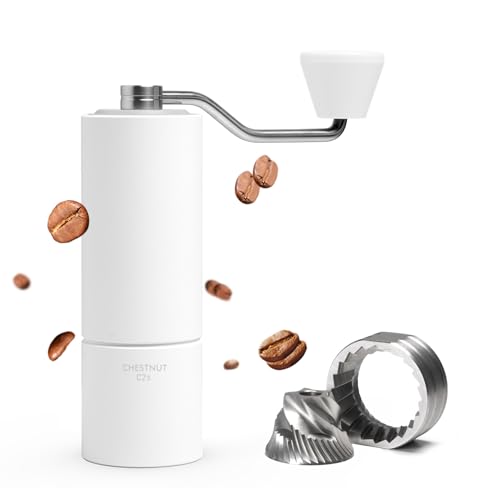
The Chestnut C2S is TIMEMORE’s metal-bodied travel grinder and the most mechanically complete design in this roundup at its size. The burr is a CNC-machined stainless steel conical burr, and the central shaft is held by a double bearing positioning system, which keeps the burr centred as you crank so the gap between burr and housing stays even around its full rotation. The body is a full metal shell rather than the plastic internal frame of the earlier C2 generation.
Grind size is set on an internal stepped adjustment dial under the burr, turned by hand after removing the grounds cup. The chamber holds about 25 g of beans as printed, which covers a large mug or a two-cup pour over in one fill. A knurled texture on the body gives grip with wet hands, and the crank knob spins freely on its own bearing.
Specs
- Burr: CNC stainless steel conical burr
- Body material: aluminum alloy, stainless steel and polycarbonate (as printed by the maker)
- Adjustment: internal stepped click dial beneath the burr
- Capacity: 25 g
- Bearings: double bearing positioning on the central shaft
3. Hario Skerton Ceramic Coffee Mill (MSCS-2DTB)
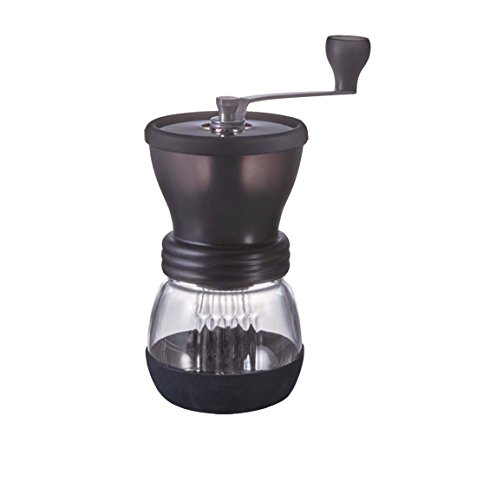
The Skerton is the jar-style school of hand grinder: a polypropylene hopper and ceramic conical burr mounted on top of a glass grounds bowl. Ground coffee falls straight into the bowl, which doubles as storage with its own lid, and the bowl is marked so you can see how much you have ground. Hario prints a bowl capacity of 100 g, the largest grounds container in this group, which suits grinding for a full pot in one session.
The ceramic burrs will not rust and can be rinsed, and grind size is set with an adjustment nut under the burr that locks in place with a screw. The hopper has a silicone lid that keeps beans from jumping out while cranking, a small detail that matters because open hoppers scatter beans. The glass bowl is the fragile element: this is the pick for a kitchen counter, not for a backpack.
Specs
- Burr: ceramic conical burr
- Body material: glass grounds bowl with polypropylene hopper
- Adjustment: locking adjustment nut beneath the burr
- Capacity: 100 g (grounds bowl, as printed by Hario)
- Extras: silicone hopper lid and storage lid for the bowl
4. Zassenhaus Brasilia Coffee Mill

The Brasilia is the traditional European box mill: a beechwood box with a chrome-plated steel top plate, an open hopper you pour beans into, and a small drawer at the base that catches the grounds. This listing is the black-stained beech version. You hold the box on your lap or against the counter edge and turn the crank with the other hand, a slower, two-handed rhythm that suits a morning ritual rather than a rush.
Inside is the long-running Zassenhaus conical burr, machined from high-grade tool steel and hardened, and the maker prints a 25-year guarantee on the grinding mechanism. Adjustment is stepless: a knurled knob on the shaft under the crank handle moves the burr closer or further, so you dial by feel and test grinds rather than by numbered clicks. Bean capacity is not stated by the maker, and the drawer is small, so expect to empty it during a full hopper’s worth of grinding.
Specs
- Burr: hardened tool steel conical burr
- Body material: beechwood box (black stained finish on this listing) with grounds drawer
- Adjustment: stepless knurled knob on the burr shaft
- Capacity: not stated
- Guarantee: 25 years on the grinding mechanism, as printed by the maker
5. KINGrinder K6 Manual Coffee Grinder

The K6 is the precision option in this group. It carries a 48 mm stainless steel conical burr, larger than the burrs in the travel cylinders above, inside an aluminum alloy body, and it moves the adjustment outside the grinder: a ring at the top of the body rotates through click settings, so you can change grind size without opening the chamber or touching the burr. This silver version has the straight handle; the maker also sells a foldable-handle version under a separate listing.
KINGrinder prints a hopper capacity range of 25 g to 30 g depending on bean size, and the grinder disassembles by hand for brushing out, with no tools needed. The external dial and larger burr suit brewers who move between espresso-fine and filter-coarse settings and want to return to a marked setting instead of counting clicks from zero. It is the heaviest grinder here and the least suited to ultralight travel kits.
Specs
- Burr: 48 mm stainless steel conical burr
- Body material: aluminum alloy
- Adjustment: external adjustment ring with click settings
- Capacity: 25–30 g (maker’s stated hopper range)
- Handle: straight handle on this listing
How to Choose
Start with the burr. Every grinder here uses a conical burr, which crushes beans between a cone and a ring rather than slicing them. Ceramic burrs (JavaPresse, Hario) resist rust and stay sharp in normal home use, but they can chip if dropped or if a stone in the beans jams them. Steel burrs (TIMEMORE, Zassenhaus, KINGrinder) tolerate more abuse and are the usual choice for fine espresso-range grinding, where the burr gap is smallest.
Match capacity to your brewer. A 25 g chamber (TIMEMORE, roughly the KINGrinder’s lower range) grinds one generous mug or a two-cup pour over per fill. If you regularly grind for a full French press or drip pot, the Hario’s 100 g bowl or a second fill from a travel grinder is the trade-off. Box mills like the Brasilia do not print a capacity, and their drawers are small, so plan on emptying mid-grind.
Decide how you want to adjust. Internal dials (TIMEMORE, JavaPresse, Hario) keep the outside clean but must be reset by counting clicks from a zero point. The KINGrinder’s external ring keeps a visible setting you can return to. The Zassenhaus is stepless, which gives infinite positions but no numbers to return to, so it suits one brewer used at one setting most of the time.
Think about where it will live. Slim metal cylinders travel well and wipe clean. The glass Hario bowl and the wooden Zassenhaus box belong on a counter, and wood should be wiped rather than washed, while the Hario’s burr and bowl parts can be rinsed as the maker directs.
Who Should Skip
Skip hand grinders entirely if you grind for a household every morning: even a fast manual grinder takes roughly a minute or more of cranking per dose, and an electric burr grinder earns its counter space at that volume. Skip the ceramic-burr models if the grinder will be thrown in a tool bag or dropped often, since ceramic can chip. Skip the box mill if you need repeatable, numbered settings for dialled-in espresso, and skip the compact travel grinders if your daily brew needs more than about 30 g at once and you do not want to grind in two fills. Anyone with limited grip strength should also look at electric models instead, because every grinder here needs sustained cranking against resistance, which increases at fine settings.
FAQ
Can hand coffee grinders grind fine enough for espresso?
Some can reach the espresso range: the makers of the JavaPresse and KINGrinder K6 list espresso among their supported methods, and steel-burr models with fine click steps give the most control at that end. Espresso also needs very repeatable settings, which is where an external, marked adjustment ring helps most.
How long does a hand grinder take per cup?
It depends on dose and setting. A typical 15–25 g dose at filter settings takes most people around a minute of steady cranking, and fine espresso settings take longer because the burr gap is smaller and resistance is higher. Larger burrs such as the K6’s 48 mm set usually clear a dose in fewer turns.
Ceramic or steel burrs: which should I choose?
Choose ceramic for rust resistance and easy rinsing in a kitchen grinder such as the Hario, and steel for durability and fine-grind control in travel or espresso-leaning use. Both materials appear in conical burrs here; the adjustment system and capacity usually matter more day to day than the burr material alone.
How do I clean a manual coffee grinder?
Most manual grinders should be brushed out with a small cleaning brush and kept dry; grinding a little stale coffee through purges old grounds from the burr path. Follow the maker’s directions: Hario’s ceramic burr and glass parts can be washed, wooden box mills should only be wiped, and steel burrs should not be soaked.
Final Verdict
Buy the TIMEMORE Chestnut C2S if you want one grinder for home and travel with a steel burr and a sensible 25 g capacity. Choose the JavaPresse for the slimmest packable cylinder, the Hario Skerton for countertop grinding into a storage bowl, the Zassenhaus Brasilia for a traditional box mill with a hardened steel burr and a long printed guarantee, and the KINGrinder K6 if an external adjustment ring and a 48 mm burr matter more than saving weight.
Product and ASIN Reference
| Product | ASIN |
|---|---|
| JavaPresse Manual Coffee Grinder | B013R3Q7B2 |
| TIMEMORE Chestnut C2S Manual Coffee Grinder | B0CGTYH2V6 |
| Hario Skerton Ceramic Coffee Mill (MSCS-2DTB) | B01LXZACFB |
| Zassenhaus Brasilia Coffee Mill | B004YIBVVQ |
| KINGrinder K6 Manual Coffee Grinder | B0GKFDZ725 |
More from Amazon
Programs that pair well with the guide above. Offers and eligibility are set by Amazon and may change.
Set up recurring deliveries of everyday items on eligible products. Terms and savings are set by Amazon.
Explore Subscribe & SaveCollect the home and kitchen items you want in one registry that guests can shop from.
Create a wedding registryFree shipping on eligible items, Prime Video and more. Eligible new members can start with a free trial.
Start a Prime free trialAudiobooks and podcasts to listen to on the go. Eligible new members can start with a free trial.
Try Audible freeAs an Amazon Associate we earn from qualifying purchases.







Write Your Review
No reviews yet. Be the first to share your experience!