

For most travelers the choice comes down to three tiers: a compressor-driven Alpicool for the lowest entry cost, an Iceco for sturdy metal construction with a premium-grade compressor, and a Dometic CFX series for the best app control, battery protection and refinement. A fourth group, thermoelectric plug-in coolers, suits short drives where you only want drinks kept cool. This guide explains what a 12V cooler is, which specs matter, and how the main brands compare, using maker specifications and independent reviewers.
Our top picks


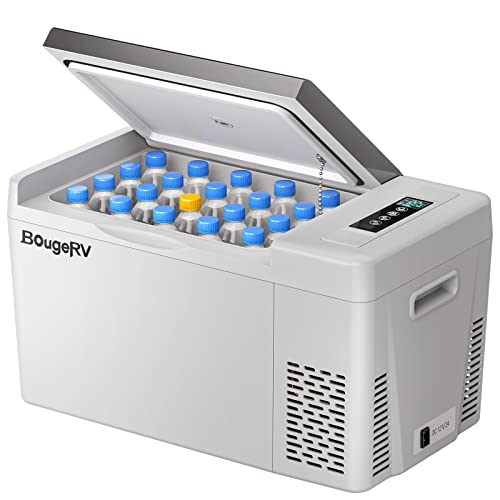
As an Amazon Associate we earn from qualifying purchases at no extra cost to you.
Two kinds of 12V cooler, and why it matters
The phrase covers two quite different products. Compressor fridge-freezers use the same refrigeration cycle as a household fridge, powered by a vehicle’s 12 or 24 volt socket or by mains through an adapter. They can hold a set temperature well below freezing even on a hot day. Thermoelectric (Peltier) coolers use a solid-state module and typically cool only to a set difference below ambient temperature, which means they struggle in a hot parked car. If you want to keep meat, dairy or ice cream safe on a multi-day trip, a compressor unit is the realistic option. If you are bringing sandwiches and soft drinks for an afternoon, a thermoelectric box may be enough.
What to compare before you buy
- Capacity. Makers quote liters. Around 40 to 55 liters fits a couple for a long weekend. Dometic lists the CFX3 45 at 46 liters total volume and the CFX3 55IM at 53 liters, roughly 83 twelve-ounce cans by the maker’s figure.
- Temperature range. Dometic lists a range from +20 degrees Celsius down to -22 degrees Celsius for these models. Iceco’s VL45 is listed at 0 to 50 degrees Fahrenheit (about -18 to 10 degrees Celsius).
- Battery protection. A cooler that can drain a starter battery is a trip-ender. Dometic describes a three-stage dynamic battery protection system; one review gives approximate cutoff voltages of 10.1, 11.2 and 11.8 volts for Low, Medium and High settings. Check what protection any model offers and whether it is adjustable.
- Power draw. Dometic publishes 0.49 kilowatt hours per 24 hours for the CFX3 45 at 5 degrees Celsius inside and 25 outside, which one source converts to roughly 41 amp hours per day from a 12 volt battery. The CFX3 55IM is listed at 0.59 kilowatt hours per 24 hours, about 49 amp hours.
- Compressor and tilt. Iceco lists a SECOP compressor in the VL45 and says it keeps running at a 40 degree tilt, a useful note for uneven campsites and rough tracks.
- Weight. A 45 liter metal-bodied unit is not light. Iceco lists the VL45 at about 48.5 pounds net, and the CFX3 55IM is around 47 pounds. Plan for two people to lift it into a truck bed.
At a glance: main contenders
| Model | Best for | Key stated specs | Limits |
|---|---|---|---|
| Dometic CFX3 45 | Premium fridge and freezer in a mid-size footprint | 46 liter volume, +20 to -22 degrees Celsius, 0.49 kWh per 24 hours, app control, three-stage battery protection | Premium tier cost, rated by reviewers as the most expensive option |
| Dometic CFX3 55IM | Overlanders who want ice on demand | 53 liters, about 83 cans, Rapid Ice Plate with silicone trays, 12/24 volt DC and 100 to 240 volt AC input, about 47 pounds | Top of the price range, heavy |
| Iceco VL45 | Rough roads, build quality, value | 45 liters, SECOP compressor, 0 to 50 degrees Fahrenheit, metal shell with 60 mm insulation, ECO and MAX modes, 12/24 volt DC and 110 to 240 volt AC | Heavy at about 48.5 pounds, controls simpler than Dometic |
| Alpicool C20 and CF45 | Entry-level compressor cooler | Compressor design, ranges from compact C20 to larger CF45 | Some reviewers report mixed long-term durability; one guide says the C20 does not go below freezing |
| Thermoelectric plug-in cooler | Day trips and commutes | Cools a set amount below ambient | Not suitable for freezing or hot parked cars |
Premium: Dometic CFX3 and CFX5
Automoblog names the Dometic CFX3 5.0 its best overall 12V cooler and describes a three-compartment, two-zone design, while other reviewers call Dometic the gold standard but note that it costs two to three times what comparable alternatives do. Road-trip guides also pick the CFX5 45, which uses a variable-speed compressor intended to keep both noise and power draw down. The Dometic CFX3 series adds a mobile app that works over Bluetooth at short range and over WiFi for remote access. The maker’s information, as summarized by reviewers, includes on and off control, a live DC voltage reading and temperature history for the last hour, day or week, plus adjustment of battery protection levels.
The CFX3 55IM adds a Rapid Ice Plate and silicone ice trays, which is the main reason to choose it over the plain 45 for week-long trips where cold drinks need ice. It is also listed with an AC input rated at 52 watts, so it can run at home on mains power for pre-chilling.
Mid-range: Iceco
Iceco appears in several roundups as the build quality pick. Reviewers highlight the all-metal construction and SECOP compressor in the VL45, with the VL35 named a good fit for rough roads and overlanding, and the VL45 ProD offered as a dual-zone variant. Retail listings describe 60 millimeter insulation, selectable ECO and MAX modes, and an operating range of 0 to 50 degrees Fahrenheit. Community forums are cited as consistently recommending Iceco for this combination. The trade-offs are weight and a less polished interface than Dometic’s app.
Budget: Alpicool
Alpicool is the usual answer when the price of a Dometic is out of reach. Automoblog gives the CF45 a high rating and calls it good value, while other reviewers say the C20 is where many buyers end up. The same sources report mixed long-term feedback, with some owners describing failures after one to two years of heavy use. One guide states the C20 cannot go below 32 degrees Fahrenheit; other sources describe it as able to freeze, so read the manual for your exact model and confirm what temperature range the maker lists.
Electrical and installation notes
- Fuse and wiring. Many vehicle sockets are fused at 10 to 15 amps. A compressor cooler draws far less than that on average, but starting current and cable length matter. Follow the manual, and consult an auto electrician for permanent hard-wired installs.
- Ventilation. The compressor needs airflow around the vents. Do not pack bedding against the intake or exhaust ports.
- Level and security. Strap the cooler down. A 45 pound unit is a hazard in a collision.
- Dual battery or power station. For multi-day use without driving, pair the cooler with a second battery or portable power station. Dometic’s quoted daily amp hours help size this.
- Engine off. Set battery protection to the High setting if the cooler is wired to the starter battery, so it cuts out before the engine will not start.
Pick the right one
| If you | Pick |
|---|---|
| Want the best app, battery protection and refinement and accept premium cost | Dometic CFX3 45 or CFX3 55IM |
| Want ice on demand during a long trip | Dometic CFX3 55IM |
| Drive rough roads and value build quality | Iceco VL35 or VL45 |
| Want two zones for fridge and freezer | Iceco VL45 ProD or Dometic dual-zone models |
| Need the lowest cost compressor cooler | Alpicool C20 or CF45, with attention to warranty |
| Only need drinks cool on day trips | A thermoelectric plug-in cooler |
Alternatives
Insulated hard cooler plus ice. A rotomolded cooler needs no power and has no moving parts. It also needs ice, and meltwater, and you must manage food safety with a thermometer.
Thermoelectric cooler. Cheap and quiet, but it cools only a limited amount below ambient. Use it for lunch, not for raw meat on a summer trip.
Portable fridge with built-in battery. Some Iceco listings bundle a 250 watt hour magnetic battery. This extends run time off-grid, but adds cost and weight.
Frequently Asked Questions
How long will a 12V cooler run on a car battery?
It depends on the model, the ambient temperature and the setting. Dometic publishes about 41 amp hours per day for the CFX3 45 under standard conditions. Starter batteries are not built for deep discharge, so use the cooler’s battery protection and consider a second battery for engine-off use.
Is a compressor cooler better than a thermoelectric one?
For food safety, yes. A compressor can hold a set temperature, including freezing, regardless of ambient heat. A thermoelectric unit only cools a fixed amount below the surrounding air.
Can I run a 12V cooler from a wall outlet?
Many compressor models accept both DC and AC input. The Iceco VL45 is listed for 12 and 24 volt DC and 110 to 240 volt AC, and Dometic lists the same dual input for the CFX3 55IM. Use the included adapter and follow the manual.
Will it drain my battery overnight?
It can if there is no protection. Choose a model with adjustable cutoff levels, set it to High when connected to the starter battery, and read the manual for how the cutoff works.
Do these coolers work on a slope or rough track?
Iceco states the VL45 compressor keeps running at a 40 degree tilt. Check the tilt limit for any model you consider, because compressors can be damaged by extreme angles.
Is the budget Alpicool worth it?
For occasional use, many reviewers say yes. Several report durability concerns after heavy use, so look at the warranty terms and keep the original packaging in case of a claim.









Write Your Review
No reviews yet. Be the first to share your experience!