

Key takeaways
- Five hydrometers for homebrew and wine making compared, from triple scale glass and polycarbonate models to the Tilt and a Brix refractometer.
As an Amazon Associate we earn from qualifying purchases.
A hydrometer is the cheapest insurance in homebrewing. Two readings, one before fermentation and one after, tell you how much sugar the yeast started with, how much remains, whether fermentation has finished, and roughly how much alcohol the batch will carry. Without those numbers you are bottling on a calendar and hoping, which is how brewers end up with flat beer, stalled wine, or bottles that keep fermenting after capping.
The five instruments below fall into three families. Triple scale glass hydrometers are the traditional pick, reading specific gravity, Brix, and potential alcohol on one stem. A polycarbonate model survives drops that end glass ones. The Tilt is a digital floating hydrometer that lives in the fermenter and reports wirelessly. The last pick is a refractometer, a different instrument entirely, labelled as such. What separates them is sample size, breakability, calibration temperature, and whether a test jar is in the box.
This article contains affiliate links, and we may earn a commission if you buy through them, at no extra cost to you.
Quick Answer
For most homebrewers, a triple scale glass hydrometer kit like the Fermtech is the simplest start, since it reads specific gravity, Brix and potential alcohol and ships with a test jar. The SP Bel-Art DURAC swaps glass for polycarbonate. The Tilt floats in the fermenter and reports wirelessly, while the CIMALAB refractometer covers brew-day checks from a few drops.
The 5 Best Hydrometers for Homebrew and Wine
1. Fermtech Glass Triple Scale Hydrometer Kit
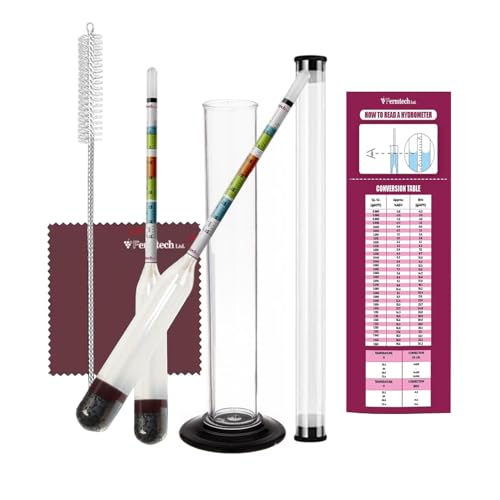
The Fermtech Glass Triple Scale Hydrometer Kit is the standard starter instrument sold as a complete kit. The glass hydrometer carries the three scales most homebrewers use: specific gravity from 0.99 to 1.17, Brix/Balling from 0 to 35, and potential alcohol from 0 to 20 percent. The Hydro+Jar version bundles a plastic test jar, so you can take a reading on day one, and the narrow jar wastes less of the batch per sample. A microfiber cloth and storage case round out the kit, and the case matters, because bare glass hydrometers usually die in a drawer. One wrinkle: Amazon’s structured included-components field names only the hydrometer, cloth, and case, even though the variant name and description promise the jar, so confirm the Hydro+Jar variant is in your cart. Fermtech does not print a calibration temperature in the listing, so check the insert in the box first.
Specs
- Type: Glass triple scale hydrometer, analog
- Specific gravity range: 0.99 to 1.17
- Brix/Balling range: 0 to 35
- Potential alcohol scale: 0 to 20 percent
- Calibration temperature: Not stated
- Test jar: Plastic test jar included with the Hydro+Jar variant
- Also included: Microfiber cloth, storage case
2. SP Bel-Art H-B DURAC Triple Scale Hydrometer

The SP Bel-Art H-B DURAC Triple Scale Hydrometer is the pick for brewers who have already broken a glass hydrometer or two. The body is polycarbonate rather than glass, and Bel-Art states it meets or exceeds the tolerance requirements of NIST Circular 55 and ASTM E100-10. Specific gravity runs from 0.990 to 1.162 in fine 0.002 divisions, potential alcohol runs 0 to 20 percent in 0.5 percent divisions, and Brix runs 0 to 35 in 0.5 divisions. Unusually, the calibration reference is printed plainly: all scales are calibrated to be read at 68 degrees Fahrenheit, and the maker’s insert includes a correction table for warmer or colder samples. At 300 mm overall (11.8 in) with a 183 mm stem, it needs a tall test jar, and no jar is bundled.
Specs
- Type: Polycarbonate triple scale hydrometer, analog
- Specific gravity range: 0.990 to 1.162, in 0.002 divisions
- Potential alcohol scale: 0 to 20 percent, in 0.5 percent divisions
- Brix range: 0 to 35, in 0.5 divisions
- Calibration temperature: 68 degrees Fahrenheit
- Length: 300 mm (11.8 in) overall; stem 183 mm (7.2 in)
- Test jar: Not stated as included
- Standards: Maker states it meets NIST Circular 55 and ASTM E100-10 tolerances
3. Kosoeur Triple Scale Hydrometer

The Kosoeur Triple Scale Hydrometer is a triple scale instrument sold with a storage case, microfiber cleaning cloth, and an instruction sheet with a conversion chart. It covers the same three measurements as the other analog picks, specific gravity, Brix, and potential alcohol. This listing most rewards careful reading, because its own copy contradicts itself twice. The description says the kit includes everything you need and one heading mentions a glass test tube, yet the package list states plainly that no hydrometer test tube jar is included, so you will need your own cylinder. The same listing also markets the instrument for proofing distilled spirits, which a triple scale brewing hydrometer cannot do; proofing requires a separate alcoholmeter. Kosoeur also leaves the numeric scale ranges and calibration temperature unstated, which is why this pick sits third.
Specs
- Type: Triple scale hydrometer, analog
- Scales: Specific gravity, Brix, potential alcohol
- Scale ranges: Not stated in the listing details
- Calibration temperature: Not stated
- Test jar: Not included, per the listing package list
- Included: Hydrometer, storage case, microfiber cloth, instruction sheet with conversion chart
4. Tilt Wireless Hydrometer and Thermometer

The Tilt Wireless Hydrometer and Thermometer takes the opposite approach to everything above it. Instead of pulling samples, you sanitize the sealed capsule and drop it into the fermenter, where it floats for the whole fermentation and broadcasts specific gravity and temperature over Bluetooth to the free Tilt app on an iPhone, iPad, or Android device, or to a Tilt Pi. The maker states a specific gravity range of 0.990 to 1.120 with accuracy of plus or minus 0.002, and temperature accuracy of plus or minus 1 degree Fahrenheit. The pre-installed CR123A battery is maker-rated at 12 to 24 months, so there is nothing to charge between batches. Because it never leaves the beer, it draws a full fermentation curve, making a stall obvious days early. Two limitations come straight from the maker. Each color is a separate unit and the app will not read two hydrometers of the same color at once, so multi-batch brewers need a different color per vessel. And because the signal is Bluetooth, stainless fermenters shorten the range to your phone. This listing is the blue version.
Specs
- Type: Digital floating hydrometer and thermometer, Bluetooth
- Specific gravity range: 0.990 to 1.120
- Maker-stated accuracy: Plus or minus 0.002 SG; plus or minus 1 degree Fahrenheit
- Temperature range: 0 to 185 degrees Fahrenheit, per maker documentation
- Battery: Pre-installed CR123A, maker-rated at 12 to 24 months
- Calibration temperature: Not stated; unit ships calibrated per the maker
- Test jar: None needed; floats directly in the fermenter
- App: Free Tilt app for iPhone, iPad, and Android, or Tilt Pi
5. CIMALAB Brix Refractometer with ATC

The CIMALAB Brix Refractometer is not a hydrometer, included because so many brewers buy one alongside a hydrometer that leaving it out would distort the roundup. A refractometer reads how a few drops of liquid bend light, so it needs drops rather than a filled test jar, making it the fastest way to check gravity during the mash and boil. This dual scale model reads Brix from 0 to 32 percent and specific gravity from 1.000 to 1.130 on the same reticle, with ATC, automatic temperature compensation, for samples not exactly at the reference temperature. The trade-off is fundamental, not a flaw in this unit: once fermentation starts, alcohol bends light differently, so a reading on fermenting beer must be corrected against the original gravity before it means anything. Brewers who want one instrument for brew day and fermentation should buy a hydrometer first. CIMALAB does not state a calibration temperature in the listing.
Specs
- Type: Refractometer, a different instrument from a hydrometer
- Brix range: 0 to 32 percent
- Specific gravity range: 1.000 to 1.130
- Temperature handling: ATC, automatic temperature compensation
- Calibration temperature: Not stated
- Sample size: A few drops on the prism
- Test jar: Not applicable
How to Choose a Hydrometer
Start with scale range. Most triple scale models top out near 1.170 specific gravity and 20 percent potential alcohol, covering beer, wine, mead, cider, and kombucha; very high gravity barleywines and dessert wines can run past the top of the stem, so check the range against your recipes. Next, find the calibration temperature before trusting a reading. The Bel-Art is explicit at 68 degrees Fahrenheit, while the Fermtech and Kosoeur listings leave it unstated, which means checking the insert in the box and cooling samples to that temperature or applying a correction. Material is the third decision: glass reads cleanly and is traditional, polycarbonate survives drops, and both need a test jar tall enough for the stem. Check whether that jar is in the box, since the Fermtech kit includes one and the Kosoeur plainly does not. Finally, decide how you want the data: a number per sample from an analog hydrometer, a continuous curve from the Tilt at one color per fermenter, or instant brew-day drops from a refractometer whose raw numbers turn unreliable once alcohol is present.
Who Should Skip These
Skip every pick here if your goal is proofing distilled spirits. A triple scale brewing hydrometer cannot read proof, and the Kosoeur listing’s suggestion otherwise is marketing, not metrology; buy a dedicated alcoholmeter scaled in proof and Tralle instead. Skip the analog models if your samples are routinely hot, since the polycarbonate DURAC is rated for room temperature use only. Skip the Tilt if you ferment in stainless steel and cannot keep a phone or Tilt Pi within Bluetooth range. And skip the refractometer as your only instrument if you need final gravity readings, because alcohol skews its numbers unless corrected against a known original gravity.
FAQ
What temperature should my sample be when I take a reading?
At the hydrometer’s calibration temperature, or close to it. The SP Bel-Art DURAC is calibrated to be read at 68 degrees Fahrenheit and ships with a correction table for warmer or colder samples. When a listing does not state the reference temperature, as with the Fermtech and Kosoeur here, check the insert in the box and cool hot wort before floating the hydrometer.
Can a refractometer replace a hydrometer?
Not completely. A refractometer like the CIMALAB is faster on brew day and uses only a few drops, but it measures refractive index, not density. Before fermentation the two agree closely enough for gravity work; after yeast starts producing alcohol, the refractometer reading has to be corrected with a calculation using your original gravity. Most brewers who own both still confirm final gravity with a hydrometer.
Can a hydrometer tell me the alcohol content of a finished beer or wine?
Not directly. The potential alcohol scale estimates what a must or wort could reach before fermentation, based on starting gravity. The finished figure comes from comparing the original gravity and final gravity readings. No hydrometer here reads the alcohol content of a finished drink in one step, and none can proof spirits.
Final Verdict
For a first instrument, the Fermtech kit is the easiest recommendation: full triple scale range, a test jar in the box, and a case to keep the glass alive. Brewers with a history of breakage, or anyone who wants the calibration temperature printed instead of implied, should take the SP Bel-Art DURAC and buy a tall jar to match. The Kosoeur works as a spare for the wine shelf if you already own a cylinder. The Tilt earns its place for brewers who ferment often and want the curve, not just the endpoints. Add the CIMALAB refractometer when brew-day speed matters more than sample size.
Product and ASIN Reference
| Product | ASIN |
|---|---|
| Fermtech Glass Triple Scale Hydrometer Kit | B09X8JHPRR |
| SP Bel-Art H-B DURAC Triple Scale Hydrometer | B077N8YM6M |
| Kosoeur Triple Scale Hydrometer | B0CBJKSXP7 |
| Tilt Wireless Hydrometer and Thermometer | B07RX2168S |
| CIMALAB Brix Refractometer with ATC | B0DBLSRNJM |
More from Amazon
Programs that pair well with the guide above. Offers and eligibility are set by Amazon and may change.
Set up recurring deliveries of everyday items on eligible products. Terms and savings are set by Amazon.
Explore Subscribe & SaveCollect the home and kitchen items you want in one registry that guests can shop from.
Create a wedding registryFree shipping on eligible items, Prime Video and more. Eligible new members can start with a free trial.
Start a Prime free trialAudiobooks and podcasts to listen to on the go. Eligible new members can start with a free trial.
Try Audible freeAs an Amazon Associate we earn from qualifying purchases.

Write Your Review
No reviews yet. Be the first to share your experience!